 Opals
Opals
 Gemstones
 Jewelry
 Coins
Coins


Sie haben bei dieser Auktion nicht geboten.
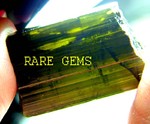
DENDRITIC FACETED QUARTZ 11.50 CTS RG-840
- Artikelnummer
- Abmessungen (mm)
- 19 x 14 x 7mm
- Gewicht (cts)
- 11.5
- Farben
-
BEAUTIFULTREEPATTERN
TREATMENT - NONE
Dendritic Quartz with it’s tree like, fern shapes and branches is a very interesting and pleasing gemstone. . Although the dendritic pattern appears as a fossilized plant, it is really inorganic manganese oxide. When moisture and iron mix, the result is oxidation, better known as rust. Oxidation is an every day occurrence. It even happened in gemstones. Traces of moisture and iron or manganese were trapped inside quartz, which produced stains resembling trees or branchescalled dendrites. The word Dendrite comes from the Greek word “dendron” meaning tree. Hence the name Dendritic or Dendrite Quartz. The stains are found in microscopic fissures that cause them to branch out like tree limbs or fern like inclusions. Of course in nature no two things are alike, making each gem one of a kind . Quartz can have inclusions of other minerals also, including, chrysocolla, azurite, malachite, chlorite or goethite. These inclusions have the ability to tint their host red, orange, yellow, green, blue and black. Dendrites can occur in other gems as well, including opal and beryl.
Dendrites are most often formed by manganese oxide or manganese oxides. Some of the other manganese oxides that form dendrites, are in the hollandite group of manganese oxides. They are coronadite, cryptomelene and hollandite. Two other manganese oxide minerals that form dendrites are romanechite and todorokite.
Like most included quartz, the primary sources of Dendritic Quartz are Brazil and Africa.
| Anbieter | Ziel | Kosten |
|---|---|---|
| DHL Standard |
Rest der Welt
14
|
erster Punkt
pro zusätzlichem Artikel
Versandkosten begrenzt auf
|
| FedEx |
Rest der Welt
7
|
erster Punkt
pro zusätzlichem Artikel
Versandkosten begrenzt auf
|
| Standard Shipping - Tracked |
Rest der Welt
14
|
erster Punkt
pro zusätzlichem Artikel
Versandkosten begrenzt auf
|
| Standard Shipping - Tracked Standard |
Australien
7
|
erster Punkt
pro zusätzlichem Artikel
Versandkosten begrenzt auf
|
| DHL Standard |
Vereinigte Staaten von Amerika
14
|
erster Punkt
pro zusätzlichem Artikel
Versandkosten begrenzt auf
|
| Express Shipping |
Australien
5
|
erster Punkt
pro zusätzlichem Artikel
Versandkosten begrenzt auf
|
| FedEx |
Vereinigte Staaten von Amerika
7
|
erster Punkt
pro zusätzlichem Artikel
Versandkosten begrenzt auf
|
| Standard Shipping - Tracked |
Vereinigte Staaten von Amerika
14
|
erster Punkt
pro zusätzlichem Artikel
Versandkosten begrenzt auf
|
- Artikelnummer
- Abmessungen (mm)
- 19 x 14 x 7 mm
- Gewicht (cts)
- 11.5
- Farben
-
BEAUTIFULTREEPATTERN
TREATMENT - NONE
Dendritic Quartz with it’s tree like, fern shapes and branches is a very interesting and pleasing gemstone. . Although the dendritic pattern appears as a fossilized plant, it is really inorganic manganese oxide. When moisture and iron mix, the result is oxidation, better known as rust. Oxidation is an every day occurrence. It even happened in gemstones. Traces of moisture and iron or manganese were trapped inside quartz, which produced stains resembling trees or branchescalled dendrites. The word Dendrite comes from the Greek word “dendron” meaning tree. Hence the name Dendritic or Dendrite Quartz. The stains are found in microscopic fissures that cause them to branch out like tree limbs or fern like inclusions. Of course in nature no two things are alike, making each gem one of a kind . Quartz can have inclusions of other minerals also, including, chrysocolla, azurite, malachite, chlorite or goethite. These inclusions have the ability to tint their host red, orange, yellow, green, blue and black. Dendrites can occur in other gems as well, including opal and beryl.
Dendrites are most often formed by manganese oxide or manganese oxides. Some of the other manganese oxides that form dendrites, are in the hollandite group of manganese oxides. They are coronadite, cryptomelene and hollandite. Two other manganese oxide minerals that form dendrites are romanechite and todorokite.
Like most included quartz, the primary sources of Dendritic Quartz are Brazil and Africa.
| Anbieter | Ziel | Kosten |
|---|---|---|
| DHL Standard |
Rest der Welt
14
|
erster Punkt
pro zusätzlichem Artikel
Versandkosten begrenzt auf
|
| FedEx |
Rest der Welt
7
|
erster Punkt
pro zusätzlichem Artikel
Versandkosten begrenzt auf
|
| Standard Shipping - Tracked |
Rest der Welt
14
|
erster Punkt
pro zusätzlichem Artikel
Versandkosten begrenzt auf
|
| Standard Shipping - Tracked Standard |
Australien
7
|
erster Punkt
pro zusätzlichem Artikel
Versandkosten begrenzt auf
|
| DHL Standard |
Vereinigte Staaten von Amerika
14
|
erster Punkt
pro zusätzlichem Artikel
Versandkosten begrenzt auf
|
| Express Shipping |
Australien
5
|
erster Punkt
pro zusätzlichem Artikel
Versandkosten begrenzt auf
|
| FedEx |
Vereinigte Staaten von Amerika
7
|
erster Punkt
pro zusätzlichem Artikel
Versandkosten begrenzt auf
|
| Standard Shipping - Tracked |
Vereinigte Staaten von Amerika
14
|
erster Punkt
pro zusätzlichem Artikel
Versandkosten begrenzt auf
|

-
Positiv
Great set of Garnets and some really cool reds when put under a bright light! Fast delivery!! Many thanks


-
 Positiv
Very fast shipping, arrived 11 days early. I think it will make a fantastic stone

-
Positiv
good seller nice packaging photos accurate of mineral

-
Positiv
good as shown in picture

Warum überbieten sich Nutzer selbst?
Wenn ein Gebot abgegeben wird, ist dies der Höchstbetrag, den eine Person für das Produkt bieten möchte. Unser System bietet dann automatisch im Namen des Bieters und erhöht das Gebot schrittweise bis zum Höchstbetrag, um die Position des Höchstbietenden beizubehalten.
Wenn ein Symbol mit der Aufschrift „Automatisches Gebot“ angezeigt wird, bedeutet dies, dass unser System aktiv Gebote für den Bieter basierend auf seinem Höchstgebot abgibt. Dies kann so aussehen, als würden die Bieter sich selbst überbieten, aber es ist lediglich das Ergebnis der Aktualisierung des Gebots durch das System, um das Höchstlimit des Bieters widerzuspiegeln.
